
Chasing Fire & Ice Across Southwest Iceland
Iceland had been on my bucket list for years, so when I spotted a seat sale in May for travel in July, I didn’t even hesitate. It felt like a sign, like the universe nudging me, and following this one was the best decision I made. This trip was everything I expected and more.

Iceland swept us up in its wild beauty from the moment we arrived. Shaped by fire and ice, it’s a place where every turn feels like stepping into another world. To make the most of our few short days, we mapped out an itinerary that let us experience the country’s most iconic and breathtaking scenic highlights.
Golden Circle
Iceland’s Golden Circle is a 300‑kilometre loop in the country’s southwest just outside Reykjavík, famous for packing some of the country’s most iconic natural wonders into one easy, scenic drive. And if you’re not renting a car, no worries—there are countless local tour operators offering full‑day Golden Circle trips, making it effortless to experience the highlights without getting behind the wheel.
The Golden Circle is a circular (or triangular) route that links three major attractions: Þingvellir National Park, the Geysir Geothermal Area, and Gullfoss Waterfall. We spent a full day driving the loop, stopping at one breathtaking spot after another.
Þingvellir National Park, a UNESCO World Heritage Site, is remarkable for both its history and geology. It is the birthplace of the Alþingi, the world’s oldest ongoing parliament, and one of the few places on Earth where you can walk between the North American and Eurasian tectonic plates.

Our first stop inside the park was Öxarárfoss, a waterfall spilling over the edge of the Almannagjá Gorge, framed by dark volcanic rock and moss‑covered lava fields. The trail to the falls is an easy, well‑marked paved path with wooden steps, which took about five minutes from the main parking lot. The whole scene felt straight out of a fairytale, and we could hear the roar of the water long before reaching the viewing platform. And because the falls sit right on the tectonic boundary, we were literally watching water plunge off the edge of a continental plate.

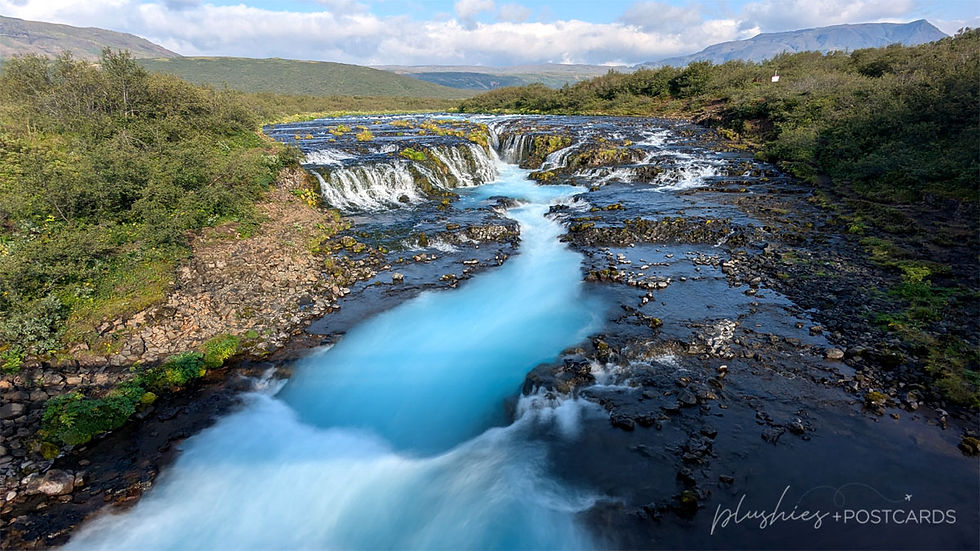
The second stop was Brúarfoss, “Iceland’s Bluest Waterfall”. It is a series of small, intricate falls where glacial meltwater from the Brúará River spills over dark volcanic rock. Its surreal, electric‑blue color comes from fine glacial sediment that reflects the light and makes the entire river glow. We honestly thought the photos online were exaggerated, but then we saw it in person and realized nope, that wild blue is 100% real.
Next was a longer stop at the Geysir Geothermal Area to watch the famous Strokkur geyser blasts boiling water up to 66 to 130 feet into the air every 5 to 10 minutes. This entire valley sits on one of Iceland’s most active geothermal fields, where underground magma superheats groundwater and creates the steam vents, bubbling pools, and mineral‑stained earth that stretch in every direction. The area is also named after the Great Geysir, the original geyser that gave the word “geyser” to languages around the world and has been documented since the 13th century.

After watching a few eruptions including one impressively tall one, we grabbed a snack and coffee at the info centre and picked up some fun and unique Icelandic souvenirs from the gift shop before heading back out on the road.
Just a few minutes away down the road is Brú Horsefarm, a family-run Icelandic horse farm located right off the highway. It is free to visit and perfect for safe, up‑close interactions, where you can feed and pet the horses. Boxes of nutritious “horse candy” are available to purchase via a QR code for 300 ISK.

The star of this day trip was Gullfoss, the legendary “Golden Waterfall” of Iceland, a massive double‑tiered cascade that drops 105 feet into a rugged canyon carved over thousands of years. The main trail from the upper viewpoint to the lower rock-level platform left us drenched from the mist but standing that close to the thunder of the falls was unreal. Back at the upper visitor centre is a cozy café and a big gift shop stocked with Icelandic wool and other local goods.

We finally stopped for lunch at Flúðasveppir Farmers Bistro, the only mushroom farm in Iceland and a hidden gem. They cultivate three varieties of mushrooms —white, chestnut, and portobello—producing about 11 tons a week from just six cabins.
While Radwin went for a burger, the kids and I went straight for the Gourmet Buffet. It came with unlimited mushroom soup, homemade garlic and sourdough bread, butter‑fried mushrooms with thyme, marinated mushrooms, bell pepper and feta pâté, bell pepper and mushroom tapenade, bell pepper and chilli jam, three kinds of butter: mushroom, bell pepper, and garlic, and coffee or tea. I was in absolute mushroom heaven.

We then spent the rest of the afternoon at the Secret Lagoon, Iceland’s oldest natural swimming pool and one of the country’s classic geothermal bathing spots. What makes it especially unique is that its water comes entirely from Vaðmálahver and Básahver, two nearby hot springs, and Litli Geysir, an active little geyser that erupts every few minutes. The sulfur‑rich water stays a steady 38 to 40°C year‑round and flows continuously, replacing itself completely every 24 hours.

After hours of driving, soaking into that warm, mineral‑rich water felt incredible. With steam rising around us, quiet countryside views, and heat slowly melting the chill from our bones, it became the most relaxing stops of the entire day.
South Coast
The South Coast is one of Iceland’s most breathtaking regions, a stretch of dramatic landscapes that feels almost unreal in its beauty. The drive itself is stunning—every few minutes reveals another postcard‑worthy scene, from waterfalls to endless moss‑covered lava fields. It is a route you can easily explore in a single day, whether you’re doing a self‑guided road trip or joining one of the many full‑day tours from Reykjavik that cover all the major highlights.
Seljalandsfoss was our first stop along the South Coast, and you can actually spot it right from the highway—its tall, ribbon‑like cascade instantly grabs your attention. The waterfall is fed by meltwater from the Eyjafjallajökull glacier, which flows down the cliffs of the ancient sea wall that once marked Iceland’s coastline. What makes this waterfall truly unique is that you can walk behind it, completing a full loop around the falls. We did it and got completely soaked but it was absolutely worth it.

Just a short walk to the left of Seljalandsfoss, about five minutes along a simple gravel trail, you’ll find the hidden Gljúfrabúi waterfall tucked between two narrow canyon walls. To see it properly, you actually have to step into the gorge itself, following a shallow stream toward the roar of the falls. It was an incredible up‑close experience, the kind that makes you feel like you’ve stumbled into a secret world. Waterproof hiking shoes are a definite must here as you’ll be wading through water and stepping on slick rocks, but the payoff is unforgettable.

Skógafoss was our next stop, one of Iceland’s most iconic and largest waterfalls, plunging an impressive 197 feet from the cliffs that once marked this island’s ancient coastline. The base of the waterfall was surprisingly shallow, and the spray was so powerful that we saw several rainbows dancing in the mist.

We also climbed the staircase, about 527 metal steps, to the top viewing platform for a completely different perspective. The stairs were somewhat steep and a bit shaky in places (there were even a couple of missing steps!), but there’s a handrail on one side and sometimes a ropeway on the other side. The top of the staircase is also the starting point of the popular Waterfall Way Hike, which forms the first section of the longer Fimmvörðuháls Trail. We only hiked as far as the first waterfall, Hestavaðsfoss, before turning back.

Fun fact: Skógafoss is a bit of a celebrity, having appeared in several major Hollywood films and popular TV series, including Thor: The Dark World and Game of Thrones.
We then traded waterfalls for the coast and made our way to Reynisfjara, Iceland’s famous black sand beach. Even from a distance, the towering Reynisdrangar sea stacks rise dramatically from the ocean, tied to local folklore that says they were once trolls turned to stone. Along the shoreline, the columnar basalt cliffs were so striking and perfectly geometric that it’s hard to believe they were shaped by nature.
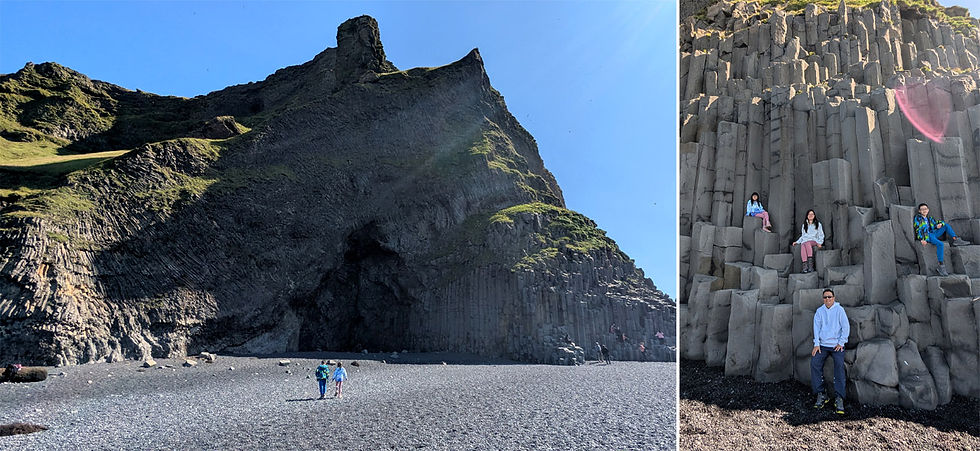
It was low tide during our visit, and the warning light was yellow meaning moderate hazard, so we were cautious as we ventured out onto the beach to explore the Hálsanefshellir cave. With the waves a safe distance away, we were able to explore the cave and basalt formations up close, taking in one of the most surreal coastal landscapes in Iceland.

We continued east to Vík, the small seaside town known for its dramatic coastal views and iconic red‑roofed church perched on the hill. For lunch, we stopped at Black Crust Pizzeria, where the pizzas are made with a striking charcoal‑infused dough that gives the crust its signature black color. Their menu was full of creative, unexpected combinations and dare I say, I never would’ve guessed that marinated duck with orange and cashew nuts, or pepperoni sausage with date pesto, could taste that delicious on a pizza.

After lunch, we made a quick stop at Skool Beans Cafe, a tiny micro coffee roaster tucked inside a converted yellow school bus. They roast their beans in small batches right on site, and you can taste the difference—the coffee was rich and smooth, and the hot chocolate was exactly the warm treat we needed.
On our way back, we made a quick stop at the Sunnumörk Shopping Center in Hveragerði, the only place in the world where you can look down into a genuine subaerial tectonic fissure and quite literally stand inside the gap separating two major tectonic plates. When the mall was under construction in 2003, workers uncovered a deep crack in the earth, and instead of relocating, the developers decided to make it a feature. They left part of the fissure exposed and installed reinforced glass panels over it, allowing visitors to peer straight down into the rift. The mall then added soft lighting inside the crevice, so its depth and structure are easier to see.
Reykjavik
You really can’t visit Iceland without spending at least one day exploring its capital. Reykjavík is packed with both free and paid activities and attractions, so whether you’re in the mood for culture, food, views, or just a relaxed wander, there’s always something to match your vibe.
The Sun Voyager is one of Reykjavík’s most iconic sculptures by Jón Gunnar Árnason. It is a steel dreamboat located along Reykjavik’s waterfront set against the sea and mountains. It’s often described as an ode to the Sun, symbolizing the promise of undiscovered territory, a dream of hope, progress and freedom. It definitely gave us Aquaman vibes.

Harpa Concert Hall is Reykjavík’s modern architectural jewel, designed to mimic the Icelandic landscape. Its famous glass honeycomb exterior is made of "quasi-bricks"—geometrically complex, 12-sided glass modules that reflect the shifting colours of the ocean and sky. Because the thousands of panes are dichromatic, the colour of the whole building shifts based on the angle of the light, reflecting hues of green, yellow, orange, purple, and blue. In contrast, the interior was built to resemble a basalt rock formation rising up from the shoreline with clean angular lines. As someone who’s always been fascinated by architecture, seeing Harpa up close was such a neat experience.

I highly recommend popping into the surprisingly large gift shop; it was way bigger than we expected. We spent ages wandering through all the Icelandic goodies, from handmade crafts to quirky little trinkets and plenty of cute souvenirs that were hard to resist.
On our search for public washrooms down on the underground level, we found a hidden gem: The Volcano Express. This immersive theatre experience blends storytelling with high‑tech visuals, motion seats, and atmospheric effects to bring Iceland’s volcanic history to life, and we somehow had the entire theatre to ourselves. The 10‑minute show was so intense and immersive, it felt unreal: rumbling seats, bursts of wind, sudden heat, and the wild sensation of flying over Iceland’s volcanoes. It ended up being one of the coolest theatre experiences we’ve ever had, and a perfect complement to everything we’d been seeing out in the real landscape.

Another surprisingly fun stop was Whales of Iceland, an immersive museum featuring 23 life‑size, hand-painted models of every cetacean species found in Icelandic waters, including a massive 25-meter (82-foot) blue whale. I thought I’d get bored quickly, but it was really fascinating. The soft lighting and ambient ocean sounds make it feel like you’re underwater, and the interactive information stations were way more engaging and educational than I expected.

Towering over Reykjavík is Hallgrímskirkja, the largest church and tallest building in Reykjavík and the city’s most recognizable landmark. Its striking design was inspired by Iceland’s basalt columns, giving it a dramatic, almost sculptural presence. While we only admired it from the outside, you can take the elevator to the 9th floor observation desk for sweeping 360-degree views of Reykjavík, the Atlantic Ocean, and the surrounding mountains.

Just steps from Hallgrímskirkja is Rainbow Street (officially Skólavörðustígur), one of Reykjavík’s most iconic pedestrian stretches, famous for its rainbow-painted pavement. The whole area is lined with boutiques, cozy cafés, restaurants, gift shops, and galleries. We wandered “just to browse” and, shocker, somehow ended up carrying a few shopping bags.

Most of the good eats around Rainbow Street are just a short stroll away.
Bæjarins Beztu Pylsur - Iceland’s most famous hot dog stand. Their hot dogs are uniquely Icelandic, made mostly with lamb (plus a bit of pork and beef), giving them a richer, slightly sweeter flavour. Go for the classic “with everything” and you’ll get ketchup, mustard, remoulade, raw onions, and crispy fried onions piled on top.
101 Reykjavik Street Food - a super casual, no‑frills spot in downtown Reykjavík serving comforting Icelandic soups. We tried almost the whole local menu and can personally vouch for the Lamb Meat Soup, Seafood Soup and Lobster Soup.
Icelandic Street Food - another cozy, casual restaurant in downtown Reykjavík that serves homestyle Icelandic comfort dishes with unlimited soup refills (yes, really!). We also tried the entire menu and loved all of it: the Fishermans Favourite (fish stew), traditional lamp soup, shellfish soup, and even the Icelandic pancakes.
Reykjanes Peninsula
Hardly anyone visits Iceland without visiting the Reykjanes Peninsula, home to the world’s most famous geothermal spa, the Blue Lagoon. Located in a black lava field, its milky-blue, mineral-rich water is naturally heated by volcanic activity and renowned for its skin-soothing properties.
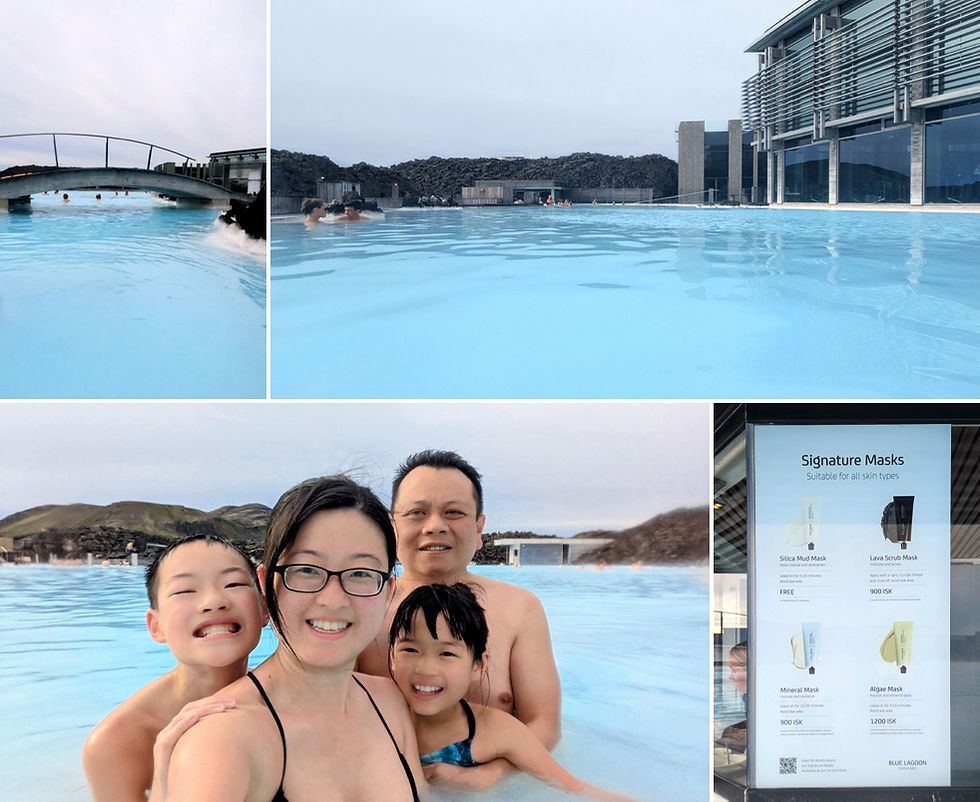
We arrived at the Blue Lagoon early in the morning, long before the crowds, and ended up staying for a good 4.5 hours (even though admission technically gives you unlimited time so you could stay until close). The milky‑blue geothermal water was warm and silky, the kind that instantly melts away any travel fatigue.

Between dips, we tried the silica facial mask, included with the admission, braved the cold plunge though it was semi-warm at its coldest, rotated through the various steam and sauna rooms, and enjoyed a refreshing drink, also included with admission, while floating in the lagoon’s misty glow. It’s touristy, yes, but also genuinely magical when you give yourself time to slow down and soak it all in. A definite must!
The peninsula is also where we tackled one of our most memorable adventures: a 10‑km return hike across rocky, muddy terrain to witness the Sundhnúkur volcanic eruption up close. The eruption began on July 16, 2025, tearing open a fissure along the Sundhnúkur row that stretched nearly 1,000 meters. The sudden activity prompted temporary evacuations of Grindavík, a nearby coastal town, and even the Blue Lagoon. The event marked the 12th eruption on the Reykjanes Peninsula since 2021 and the 9th in the Sundhnúkur system since late 2023.

When we visited, the eruption had slowed down so much that only a single cone was still producing lava, and it was completely safe to view from a distance. Even so, it was undeniably one of the coolest things we’ve ever experienced – not many people can say they hiked out to a volcano, watched it in action, and even touched the hardened lava rocks that were molten lava just weeks earlier. The eruption officially ended on August 5, 2025, a week after we returned home.
Lastly, just a short drive away is one of Reykjanes’ most unique landmarks: the Bridge Between Continents, where you can literally walk from the North American tectonic plate to the Eurasian plate in just a few steps. It was a simple stop, but standing between two continents still feels surreal — or in our case, being “separated” by about 30 steps.

Overall
Iceland had been sitting on my bucket list for years, and somehow it still managed to meet and honestly exceed every expectation I had. The landscapes were so staggeringly beautiful it almost hurt to look at them, the kind of scenery that stays with you long after you’ve flown home. From waterfalls and black‑sand beaches to lava fields still warm from recent eruptions, every day felt like stepping into another world. We barely scratched the surface of the southwest, and I already can’t wait to return and explore even more of this incredible country.


Comments